Aha Macav High School in Mohave Valley, AZ, serves 35 students across grades 9鈥�12 with no reported teaching staff, resulting in an unavailable student鈥搕eacher ratio.
Math proficiency in 2023 is 35%, which is approximately equal to the Arizona state average of 34% but significantly lower than the district average of 58%.
Reading proficiency is 27% in 2022, which is lower than the state average of 40% and well below the district average of 60%, showing a declining trend from previous years.
Science proficiency was reported as 20% in 2022, also lower than the state average of 24% and district average of 37%.
Enrollment has remained stable at 35 students over the last several years, with a predominantly American Indian student body representing 74% of enrollment, indicating a consistent demographic composition for this rural Arizona high school.
School Overview
Grades Offered
Grades 9-12
Total Students
35 students
Total Classroom Teachers
n/a
School Rankings
Student-Teacher Ratio
n/a
17:1
American Indian
74%
5%
Asian
n/a
3%
Hispanic
14%
48%
Black
3%
6%
White
9%
34%
Hawaiian
n/a
n/a
Two or more races
n/a
4%
All Ethnic Groups
School Statewide Testing
School District Name
Higley Unified School District (4248)
Source: National Center for Education Statistics (NCES), AZ Dept. of Education
Frequently Asked Questions
How many students attend Aha Macav High School?
35 students attend Aha Macav High School.
What is the racial composition of the student body?
74% of Aha Macav High School students are American Indian, 14% of students are Hispanic, 9% of students are White, and 3% of students are Black.
What grades does Aha Macav High School offer ?
Aha Macav High School offers enrollment in grades 9-12
What school district is Aha Macav High School part of?
Aha Macav High School is part of Higley Unified School District (4248).
Recent Articles

Multilingual Learner Growth Models & Accountability
Learn how multilingual learner growth models are reshaping school accountability systems and what it means for public schools in 2026.

School-Based Health Clinics: Funding, Billing, and Student Access
Learn how school-based health clinics are funded, how billing works, and how students access care in public schools.
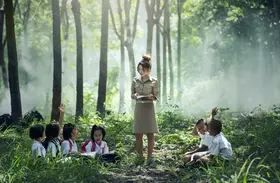
Outdoor Learning in Urban Schools: Forest School Programs
Explore how urban districts adopt outdoor learning and forest school programs to boost student engagement, well-being, and academic success.