
For the 2026 school year, there are 8 public elementary schools serving 2,339 students in 98201, WA.
The top-ranked public elementary schools in 98201, WA are Whittier Elementary School, Port Gardner and Garfield Elementary School. Overall testing rank is based on a school's combined math and reading proficiency test score ranking.
Public elementary schools in zipcode 98201 have an average math proficiency score of 41% (versus the Washington public elementary school average of 43%), and reading proficiency score of 54% (versus the 51% statewide average). Elementary schools in 98201, WA have an average ranking of 6/10, which is in the top 50% of Washington public elementary schools.
Minority enrollment is 53% of the student body (majority Hispanic), which is more than the Washington public elementary school average of 52% (majority Hispanic).
Best 98201, WA Public Elementary Schools (2026)
School
(Math and Reading Proficiency)
(Math and Reading Proficiency)
Location
Quick Facts
Rank: #11.
Whittier Elementary School
(Math: 72% | Reading: 75-79%)
Rank:
Rank:
10/
Top 10%10
916 Oakes Ave.
Everett, WA 98201
(425) 385-4300
Everett, WA 98201
(425) 385-4300
Gr: PK-5 | 433 students Student-teacher ratio: 17:1 Minority enrollment: 38%
Rank: #22.
Port Gardner
Alternative School
(Math: 40-49% | Reading: 70-79%)
Rank:
Rank:
8/
Top 30%10
3516 Rucker Ave.
Everett, WA 98201
(425) 385-5150
Everett, WA 98201
(425) 385-5150
Gr: K-12 | 95 students Student-teacher ratio: 32:1 Minority enrollment: 31%
Rank: #33.
Garfield Elementary School
(Math: 55-59% | Reading: 55-59%)
Rank:
Rank:
8/
Top 30%10
2215 Pine St.
Everett, WA 98201
(425) 385-4700
Everett, WA 98201
(425) 385-4700
Gr: PK-5 | 392 students Student-teacher ratio: 16:1 Minority enrollment: 57%
Rank: #44.
Jackson Elementary School
(Math: 40-44% | Reading: 50-54%)
Rank:
Rank:
6/
Top 50%10
3700 Federal Ave.
Everett, WA 98201
(425) 385-5600
Everett, WA 98201
(425) 385-5600
Gr: PK-5 | 313 students Student-teacher ratio: 14:1 Minority enrollment: 50%
Rank: #55.
North Middle School
(Math: 31% | Reading: 54%)
Rank:
Rank:
5/
Bottom 50%10
2514 Rainier Ave.
Everett, WA 98201
(425) 385-4800
Everett, WA 98201
(425) 385-4800
Gr: 6-8 | 678 students Student-teacher ratio: 20:1 Minority enrollment: 56%
Rank: #66.
Hawthorne Elementary School
(Math: 25-29% | Reading: 20-24%)
Rank:
Rank:
2/
Bottom 50%10
1110 Poplar St.
Everett, WA 98201
(425) 385-4600
Everett, WA 98201
(425) 385-4600
Gr: PK-5 | 426 students Student-teacher ratio: 16:1 Minority enrollment: 64%
Rank: n/an/a
Pass Program
Alternative School
2731 10th St. Suite 106
Everett, WA 98201
(425) 388-7877
Everett, WA 98201
(425) 388-7877
Gr: 6-12
Rank: n/an/a
2801 10th Street
Everett, WA 98201
(425) 388-7822
Everett, WA 98201
(425) 388-7822
Gr: 6-12 | 2 students
98201, Washington Public Schools (Closed)
School
Location
Quick Facts
Summit Program Elementary School (Closed 2005)
Alternative School
11401 Beverly Park Rd
Everett, WA 98201
(425) 356-1301
Everett, WA 98201
(425) 356-1301
Gr: 3-5 | 137 students Minority enrollment: 13%
Frequently Asked Questions
What are the top-ranked public elementary schools in 98201, WA?
The top-ranked public elementary schools in 98201, WA include Whittier Elementary School, Port Gardner and Garfield Elementary School.
How many public elementary schools are located in 98201?
8 public elementary schools are located in 98201.
What is the racial composition of students in 98201?
98201 public elementary schools minority enrollment is 53% of the student body (majority Hispanic), which is more than the Washington public elementary schools average of 52% (majority Hispanic).
Recent Articles

Multilingual Learner Growth Models & Accountability
Learn how multilingual learner growth models are reshaping school accountability systems and what it means for public schools in 2026.

School-Based Health Clinics: Funding, Billing, and Student Access
Learn how school-based health clinics are funded, how billing works, and how students access care in public schools.
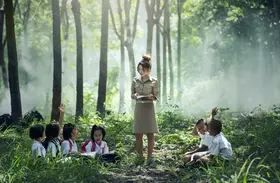
Outdoor Learning in Urban Schools: Forest School Programs
Explore how urban districts adopt outdoor learning and forest school programs to boost student engagement, well-being, and academic success.